
Categories
Written Expression and Its Challenges
Understanding the Root Causes, Characteristics, and Interventions for Struggling Writers
Introduction
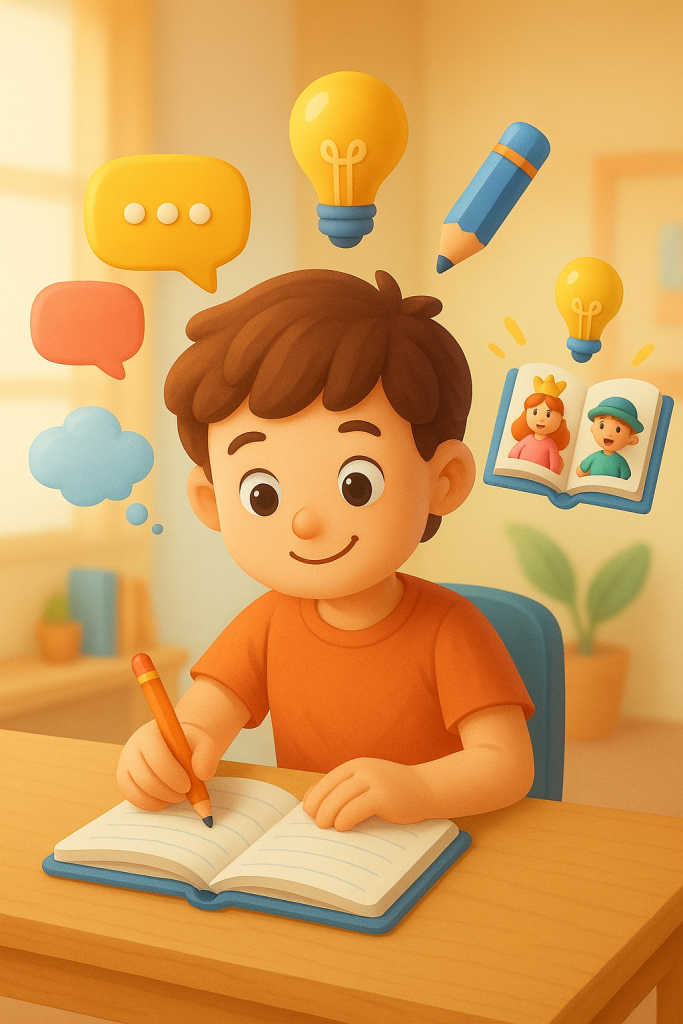
Imagine asking a child to write a sentence about their school day, and they stare at the paper for a few seconds, then write: “School… play… friends,” and stop. No coherence, no sequence, no clarity. What’s the reason? Laziness? Low intelligence? Or is it something deeper than simply holding a pen? The truth is that written expression is not just a linguistic skill; it is a complex, integrative outcome involving cognitive, linguistic, sensory, and emotional processes. It is one of the most prominent challenges faced by children, especially those with learning difficulties, language disorders, intellectual disabilities, and autism spectrum disorder. These children may have wonderful ideas in their minds, but they struggle to translate them into clear and connected sentences. In this educational scientific article, we take you on a journey to understand written expression, its features, major problems, and intervention and training strategies for each age group.
What Is Written Expression?
Written expression is the ability to convey ideas, information, and emotions to the reader through a clear and organized written text. It requires: appropriate vocabulary usage, grammatically correct sentences, logical organization of ideas, awareness of the target reader, and revising and editing the text. It is a complex skill linked to various cognitive functions such as: working memory, executive organization, receptive and expressive language, and fine motor skills.
Common Writing Challenges in Children
The types of difficulties vary by age, cognitive level, and language ability. The most common are:
At the text level: unconnected ideas, text lacking an introduction or conclusion, weak chronological or logical sequencing.
At the sentence level: incomplete or meaningless long sentences, repetitive expressions, poor vocabulary use.
At the motor level: very slow handwriting, illegible script, quick fatigue during writing.
At the executive level: difficulty planning before writing, inability to revise the text, struggle to generate or organize ideas.
How Writing Challenges Vary by Age
(ages 4–6):
Limited oral expression, writing isolated words only, reliance on drawing instead of writing.
(ages 7–12):
- Unconnected sentences, difficulty using punctuation, and avoidance of writing tasks.
- Preparatory and Secondary Stages
(ages 13–18):
- Long, unstructured writing, weak argument or analysis, formulaic and unoriginal texts.
Tools to Assess Writing Difficulties
For accurate diagnosis, multiple assessment tools are used, including: analyzing writing samples (number of sentences, errors, coherence), standardized and free writing tests, observing writing performance during tasks, assessing the gap between oral and written expression, and executive function tests (planning, sequencing, attention).
Academic & Emotional Impact
Poor performance across all academic subjects (Arabic, science, math…), difficulties in long-answer exams, loss of motivation and self-confidence, avoidant behaviors (refusal, crying, distraction).
Effective Intervention and Treatment Strategies (By Age Group)
(4–6):
- Storytelling with wordless picture books, using incomplete sentence prompts: (“I like to…” / “On Eid…”), drawing then writing about the drawing.
(7–12):
- Practicing mind mapping before writing, classifying words and linking them to themes, using “help cards” like: Who? What? Where? When? Why?
(13–18):
- Training in opinion writing and justification, using the “RAFT” model (Role, Audience, Format, Topic), peer review to encourage critical thinking.
Recommendations for Specialists and Educators
Accurately identify the type of problem: linguistic? executive? motor? Don’t start with correction… start with building trust, use dynamic assessment, not just written tests, train the child on planning and self-editing with clear steps, apply gradual training: word → sentence → paragraph → essay.
The Family’s Role in Supporting Written Expression
Allocate a “daily writing notebook” for the child, write greeting cards or describe real-life events, shared storytelling: “I start the sentence, and you finish it,” encourage free writing without harsh correction at first, engage in shared reading and discussing picture books.
Conclusion
Written expression is not a side skill—it is the foundation upon which all academic learning is built. The more a child can turn their thoughts into words, the more they can assert themselves and achieve academically and socially. Always remember, supporting a child in this skill requires patience, understanding, and evidence-based strategies. Do you feel your child struggles with writing? Do you work with students facing these challenges daily? Share this article with those who care, and take the first step toward helping a child express themselves with confidence and clarity. Leave us a comment: What hinders your children the most in writing? Subscribe to our YouTube channel and Facebook page for more educational videos on disabilities, autism, and learning difficulties.
Scientific References
Graham, S., & Harris, K. R. (2019). Evidence-Based Writing Practices for Students with Learning Disabilities. Journal of Learning Disabilities.
Berninger, V., & Richards, T. (2020). Teaching Students with Dyslexia, Dysgraphia, OWL LD, and Other Learning Differences: Lessons from Science. Brookes Publishing.
National Center for Learning Disabilities. (2023). The State of Learning Disabilities: Understanding the 1 in 5.
International Dyslexia Association. (2022). Writing Instruction: What Do We Know?
Ministry of Education – Arab Republic of Egypt. (2021). Guide for Supporting Students with Learning Difficulties.
UNESCO (2022). Inclusive Education and Learner-Centered Teaching: A Reference for Teachers and Practitioners.
- Subscribe to our [YouTube Channel] and follow us on [Facebook] for more expert content on disability, autism, and learning difficulties.
- Share this article with those who care.