
The role of the educational aide in inclusive education
Introduction
In recent decades, education worldwide has undergone a major shift, with school inclusion becoming a cornerstone to guarantee the right of all children—including those with disabilities—to fair and equitable education. Among the many factors that influence the success of inclusion, the role of the educational aide, also known as the shadow teacher, has emerged as one of the most decisive elements. But who exactly is the shadow teacher? What sets them apart from other school staff? And is their role limited to one-on-one support in class, or do they serve as a bridge linking the family, teachers, and the child?
1. Concept of the Educational Aide or Shadow Teacher
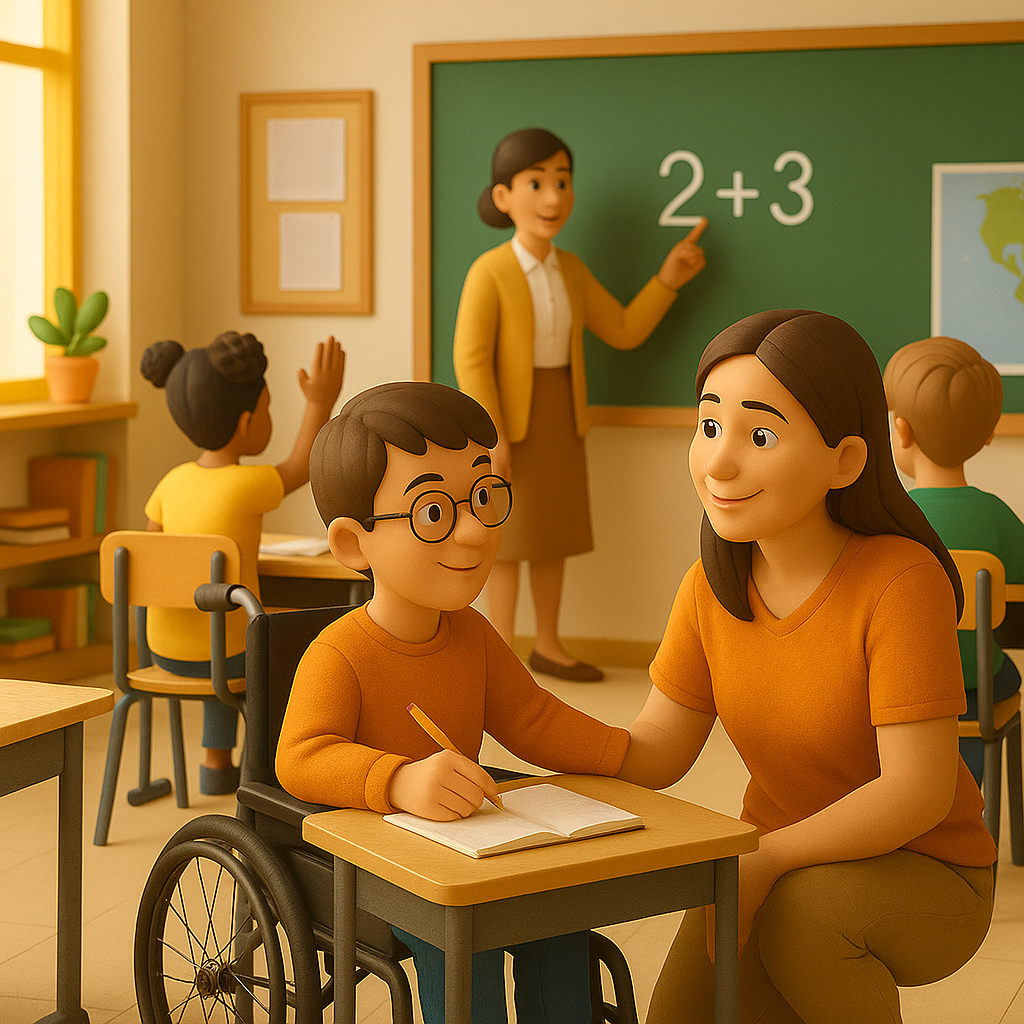
The shadow teacher is a specialized professional who works alongside a student with disabilities in the classroom. Their role is to support the student in accessing information and participating effectively in both academic and social activities. According to UNESCO (2020), the presence of a well-trained shadow teacher significantly enhances opportunities for inclusive education and is considered a strategic factor in the success of integration programs.
2. Required Skills of a Shadow Teacher
The effectiveness of a shadow teacher is not about merely “being physically present” next to the student. It depends on possessing a comprehensive set of skills, such as:
Educational skills: Understanding the basics of special education and strategies for individualized and inclusive learning.
Behavior management: Applying behavioral modification programs (e.g., Applied Behavior Analysis – ABA).
Social and communication skills: Building trust with the student and collaborating effectively with teachers and families.
Flexibility and attentiveness: Handling unexpected classroom situations without disrupting learning.
Documentation and evaluation: Preparing daily or weekly progress reports to support the individualized educational plan.
3. Preparation and Training Requirements
Modern educational literature emphasizes that preparing shadow teachers should follow structured stages:
Theoretical preparation: Studying child development, learning psychology, and the philosophy of inclusive education.
Practical training: Hands-on practice within inclusive classrooms under specialist supervision.
Continuous development: Attending workshops, online training courses, and keeping up with the latest research.
WHO and the World Bank (2022) recommend incorporating skills in accessibility and multimodal communication into shadow teacher training programs to ensure effective support for children with autism and developmental disabilities.
4. Roles of the Shadow Teacher in School
In the school setting, shadow teachers take on multiple roles, including:
Facilitating the student’s participation in lessons and activities.
Simplifying instructions and offering alternative tools (cards, visuals, sensory aids).
Assisting in curriculum adaptation to match the student’s abilities.
Reinforcing positive behavior and encouraging independence.
Coordinating consistently with teachers and school specialists.
5. Roles of the Shadow Teacher at Home
The responsibilities of a shadow teacher extend beyond the school walls, such as:
Training the child on daily skills that enhance classroom participation.
Assisting with homework in ways suited to the child’s abilities.
Supporting the family in carrying out the Individualized Educational Plan (IEP).
Linking what the student learns in school to their home and social environment.
6. Challenges and Solutions
Despite their importance, shadow teachers face several challenges, such as:
Student overdependence on the teacher → Solution: Gradual plans to foster independence.
Lack of coordination with teachers → Solution: Weekly coordination meetings.
Workload and pressure → Solution: Integrating the shadow teacher into a multidisciplinary support team.
Conclusion
A shadow teacher is not simply an assistant to an individual student but a strategic partner in the journey of inclusion. Their role requires continuous academic and professional training. Their success relies not only on personal effort but also on teamwork with families, schools, and specialists. To achieve sustainable and equitable inclusion for our children, we must re-evaluate how shadow teachers are prepared and supported as an essential part of inclusive education systems.
Discussion point: What challenges have you faced with shadow teachers in your schools, and how do you think their role can be further developed? Share this article to spread awareness among families, teachers, and specialists.
References
Arabic References
Egyptian Ministry of Education (2023). Regulatory Guidelines for Inclusive Education. Cairo.
Arab Center for Educational Research for the Gulf States (2022). Inclusive Education: Concepts and Applications. Kuwait.
Foreign References
UNESCO (2020). Guidelines for Inclusion and Equity in Education. Paris: UNESCO.
WHO & World Bank (2022). Global Report on Disability and Education. Geneva: WHO.
American Psychological Association (APA) (2023). Best Practices for Inclusive Classrooms. Washington, DC: APA.
Autism Speaks (2022). The Role of Shadow Teachers in Inclusive Education.
Alnahdi, G. H. (2023). Shadow Teacher Effectiveness in Inclusive Schools: A Systematic Review. Journal of Special Education.
- Subscribe to our [YouTube Channel] and follow us on [Facebook] for more expert content on disability, autism, and learning difficulties.
- Share this article with those who care.