
Developmental Learning Disabilities
Understanding the Hidden Roots of Learning Struggles
Introduction
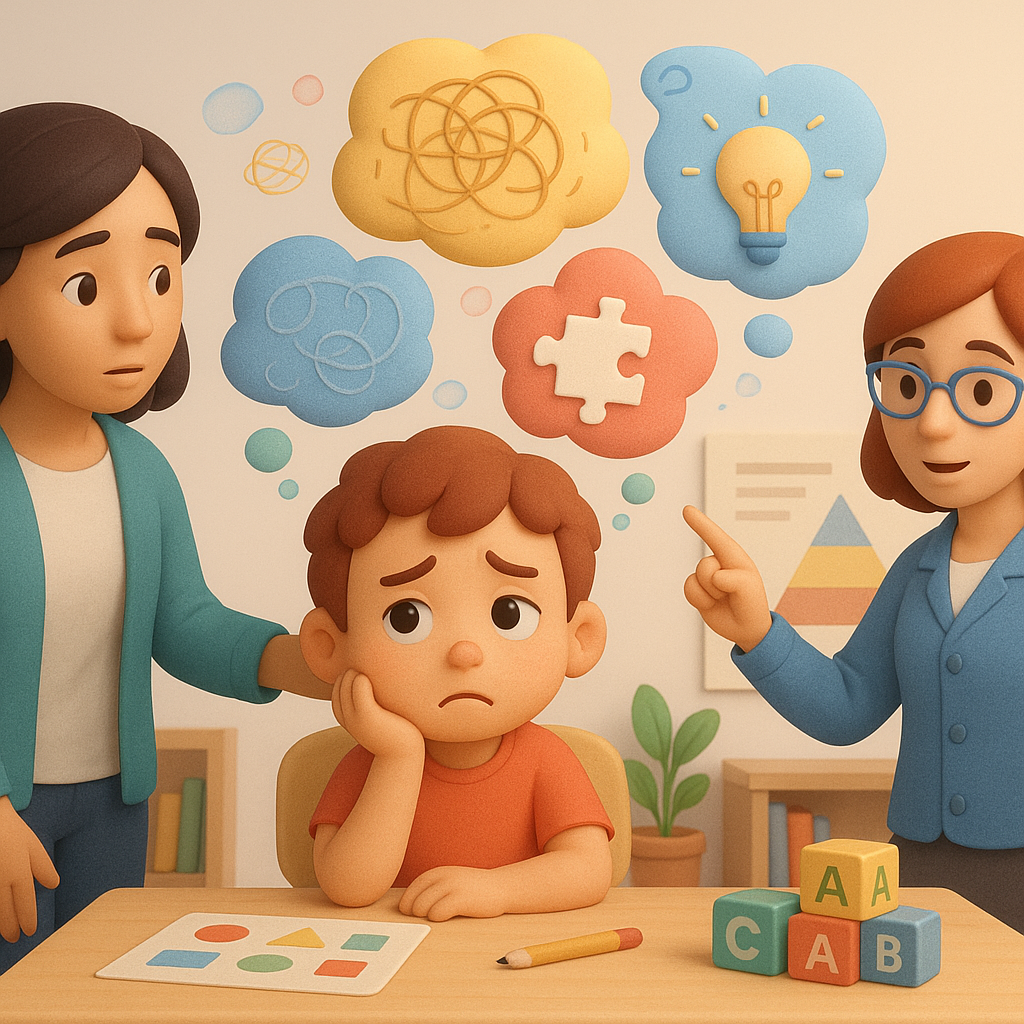
In every classroom, there’s a child who seems bright, witty, and cheerful… but struggles to tie their shoelaces, organize their thoughts, remember instructions, or seems “lost in another world.” These signs are often misinterpreted as laziness or low intelligence, but the truth is deeper. We’re likely looking at Developmental Learning Disabilities—the hidden roots that block learning from the start. So what are these difficulties? How do we distinguish them from normal developmental variations? When do we diagnose them? And most importantly: how do we intervene early before they become long-term academic impairments?
1. What Are Developmental Learning Disabilities?
They are disorders affecting high-level mental functions responsible for processing information: attention, perception, concept formation, memory, and problem-solving. When one of these is impaired, it becomes difficult for a child to learn core skills—even with average or above-average intelligence.
2. When Do These Difficulties First Appear?
They usually emerge between ages 3–5 and become clearer in early school years. Some may mistake them for delays that will pass, but waiting without intervention can lead to worsening problems and academic learning disorders like dyslexia or dyscalculia.
3. Main Types and Symptoms
Attention difficulties: easy distraction, task incompletion, forgetfulness, hyperactivity, poor organization.
Perceptual difficulties: confusion in directions, difficulty differentiating sounds/letters, poor eye-hand coordination.
Conceptual difficulties: poor understanding of size/sequence, literal thinking, difficulty generalizing.
Memory difficulties: forgetting instructions, rapid information loss, struggling with multi-step tasks.
Problem-solving difficulties: weak alternative thinking, avoidance, low persistence.
4. Academic Impact
They affect the learning cycle: receiving – understanding – storing – retrieving – applying. Any disruption can lead to poor performance, frustration, and behavioral withdrawal or aggression.
5. Developmental vs. Academic Disabilities
Developmental ones occur before formal schooling; academic ones result from them—like dyslexia, dysgraphia, and dyscalculia. Early diagnosis of developmental issues can prevent academic ones.
6. How Are They Diagnosed?
Through a multi-disciplinary evaluation: family interviews, developmental checklists, classroom observations, cognitive and intelligence testing, and tools like WISC-V, NEPSY-II, and Conners Scales.
7. Effective Interventions
There’s no direct medication; instead, we rely on cognitive-behavioral training, Individualized Education Plans (IEPs), speech and occupational therapy, behavior modification, parent coaching, and ongoing emotional support.
8. Golden Tips for Parents
Observe your child early, don’t wait for school to report problems, seek early evaluations, avoid blaming, collaborate with professionals, celebrate small progress, encourage memory games, and ensure a stimulating learning environment.
Conclusion:
Developmental learning disabilities are not a stigma—they are a lens through which we better understand a child’s mind. With early diagnosis, the right support, and joint efforts from home and school, every child can grow and thrive in their own way.
Sources & References:
Barkley, R. A. (2015). ADHD Handbook.
Flanagan & Alfonso (2017). WISC-V Essentials.
Lerner & Johns (2014). Learning Disabilities.
Feuerstein (2005). Instrumental Enrichment.
Egyptian Ministry of Education – 2021
Arab Network for Learning Disabilities – 2022–2024
- Subscribe to our [YouTube Channel] and follow us on [Facebook] for more expert content on disability, autism, and learning difficulties.
- Share this article with those who care.